
What Is Parent Participation Childcare? A Guide for BC Families
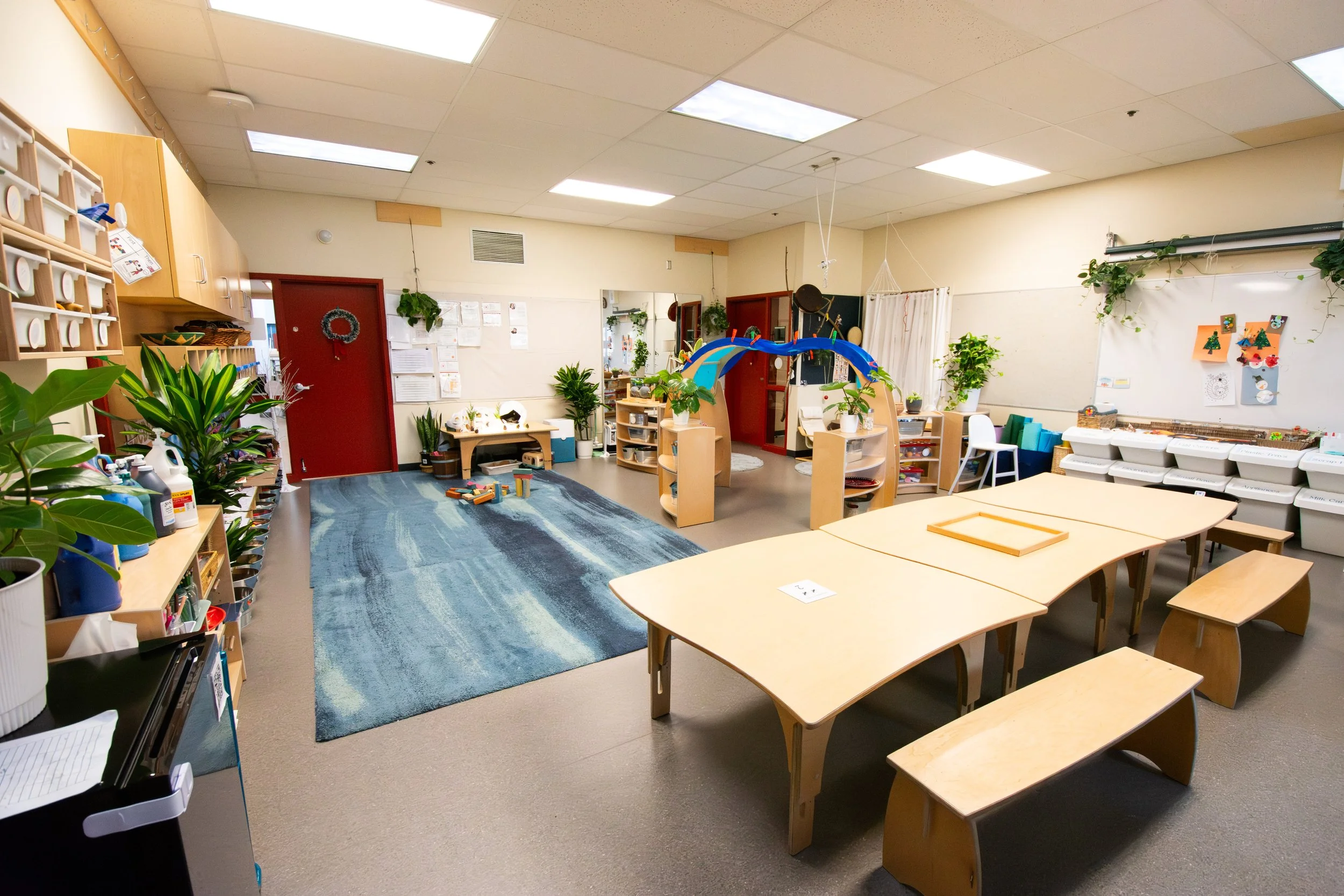
For most childcare programs, parents drop off their child in the morning, pick up in the afternoon and are reliant on teacher feedback or photos to learn about the day. Parent participation childcare is something different — a model where families aren't just clients of a program, but genuine members of a community that helps shape it. For some families, it's the best fit they ever find. For others, it's not realistic. This guide will help you figure out which you are.
So what does it actually mean?
A parent participation childcare program is a licensed program where families contribute time each month. That contribution can take a lot of forms — helping in the classroom, administrative support, governance, communications, maintenance — depending on the program and what works for your life.
Parent participation programs in BC have deep roots. They grew out of the parent participation preschool movement of the mid-twentieth century, when families decided they wanted more say in their children's earliest learning. These programs are still running strong, and parents can learn more at https://www.cpppbc.ca/.
To address the child care needs of the 2026 family - rather than family of decades ago that had a stay-at-home parent and only needed part-time preschool care - many of those parent participation preschools have grown into full-day licensed programs. SSOCC's programs carry on that tradition.
How it works at SSOCC
At our parent participation programs in Richmond and Vancouver, the commitment is simple:
One shift - Three hours.
Once a month - Per enrolled child.
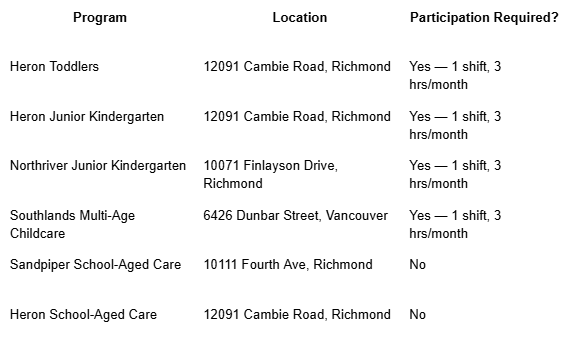
That applies at Heron Toddlers, Heron Junior Kindergarten, Northriver Junior Kindergarten, and Southlands Multi-Age Childcare.
Our school-aged programs — Sandpiper and Heron School-Aged Care — do not have a participation requirement.
What might a shift look like?
Shifts are designed to flex around real family life. Depending on your schedule and skills, participation might look like:
A classroom shift — three hours in the program, helping educators with snack, materials, deep cleaning or providing one:one support for activities that require more intensive adult support
Administrative support — emergency card updates, welcome packages
HR help — hiring and interview coordination, policy review, procedure implementation
Communications — newsletters, calendars, social media
Curriculum prep — making playdough, organizing art supplies, refreshing materials
Facility and maintenance work
Some families love classroom shifts because it gives them a real window into their child's day. Others prefer working from home on a spreadsheet or newsletter. Our program managers identify the most urgent needs for the classroom and create monthly volunteer sign up lists for their location.
What if a month gets away from you?
It happens. Work trips, new babies, a season that just flattens you — life doesn't always cooperate. When it doesn't, families work with their program manager to swap with another family, double up the following month, or contribute in a different way. The requirement is real, but it's designed to bend.
Is parent participation right for your family?
Parent Participation tends to work well for families with some schedule flexibility, those who want a deeper sense of community, or anyone who wants a genuine window into what their child's day actually looks like.
It can be harder to sustain if both parents work rigid full-time schedules with no extended family nearby. That's not a judgment — it's just realistic. For these families, volunteer shifts might need to be more deliberately planned - for example, volunteering on a field trip day for 6 hours and filling 2 months of shifts in one day.
What families often discover
Beyond knowing your child's educators and classmates, families in parent participation programs often find things they didn't expect:
Community. In a city as transient as the Lower Mainland, a parent participation program can be one of the few places where you actually build lasting relationships with the people living near you.
Real influence. Parents have a genuine voice in how the program runs. SSOCC families can vote at the June AGM, attend PAC meetings, and sit on the Executive PAC board.
A new lens on your own child. Spending time in a Reggio-inspired classroom changes how a lot of families parent at home. Many tell us they learned things about their child during a shift that they wouldn't have discovered any other way.
Cost-effectiveness. Family contributions help keep operating costs manageable — which supports strong educator wages and rich learning materials.
Governance and community
SSOCC is a not-for-profit society — there's no private owner. The society is governed by a small board of directors and the larger parent advisory committee. Families can run for the executive PAC, vote at the AGM in June, make recommendations for the Board of Directors approval, and attend PAC meetings throughout the year.
Which SSOCC programs require participation?
Common questions
Is this the same as a co-op daycare? The terms overlap a lot. Co-op daycares are usually parent-taught, while parent participation programs like ours are run by BC qualified educators, with families contributing through shifts and governance rather than running things themselves.
Do I need experience teaching young children? Not at all. Educators direct the shift. You'll get clear guidance on where to help and where to step back. Most parents arrive a little nervous and leave feeling surprisingly capable. And some parents choose to only sign up for non-teaching shifts - cleaning, organization, administration or classroom material preparation.
Can a grandparent or another caregiver do my shift? Yes — many families share shifts across caregivers. Talk to your program manager to set that up.
Can two full-time working parents make this work? Yes - with planning. Families with flexible grandparents, or who can take on at-home administrative shifts in the evenings or weekend often manage it well. Others find a non-participation program is a better fit.
Come see it for yourself
The best way to understand parent participation is to walk into a program and meet the families who are already in it. Reach out at registration@ssocc.ca to book a tour of Heron Toddlers, Heron JK, Northriver JK, or Southlands Multi-Age. We'll help you figure out whether this model fits your family — and if it does, we'll be glad to welcome you in.
