
Toddler Childcare in Richmond, BC: A Parent's Guide to 12–36 Months at Heron Toddlers
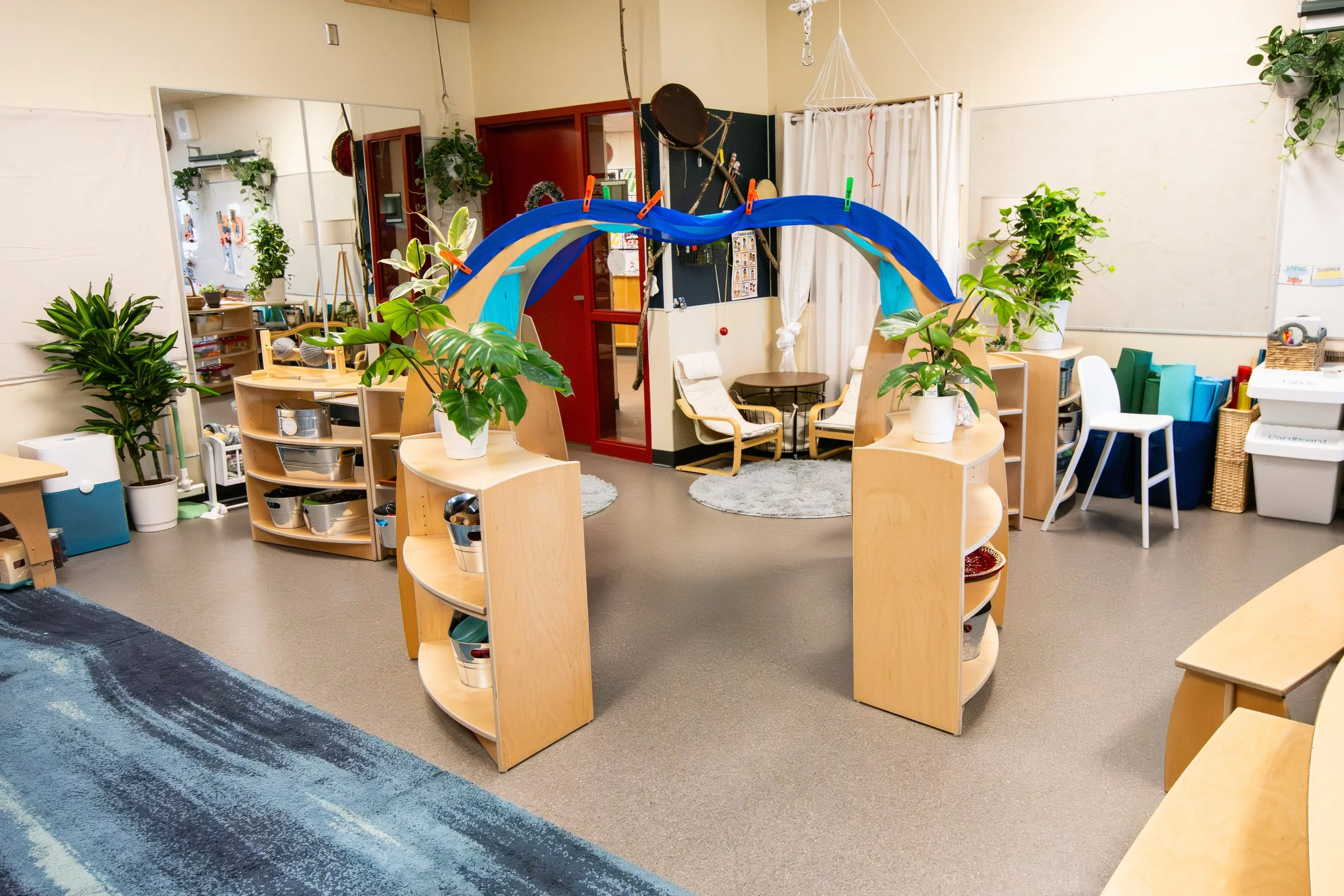
The transition from parental leave to full-time toddler childcare is one of the biggest emotional shifts a family ever goes through. You're not just choosing a program — you're choosing the place where your child learns to trust adults outside the family, makes their first friendships, and figures out who they are as a person in a community.
This is the world Heron Toddlers is built for. Below, we walk through what high-quality toddler care looks like for children 12–36 months, how Heron Toddlers works, and what families can expect when they make this transition.
What's developmentally happening between 12 and 36 months?
Twelve to thirty-six months is one of the most intense developmental windows a person ever has. In two years, a child typically:
Goes from a few first words to short sentences and rich pretend play
Moves from walking unsteadily to running, climbing, and complex motor skills
Begins to recognize and name emotions in themselves and others
Develops early self-regulation — though they'll still need a lot of help
Forms strong, specific attachments to caregivers beyond the family
Begins to understand routines, predictability, and time
Starts asking real questions about how the world works
What this means practically: toddlers need predictable environments, low ratios, and educators who really know them. They're not too young to be doing serious learning — they're at the peak of it.
What licensed toddler care in BC actually requires
Under BC's Community Care and Assisted Living Act, group toddler programs (called "Group Multi-Age" or "Group Infant-Toddler" depending on age range) have specific legal requirements:
Ratios: 1 adult for 1–4 infants and toddlers; 2 adults (1 ITE + 1 ECE) for 5–8; 3 adults (1 ITE + 1 ECE + 1 ECEA) for 9–12.
Qualifications: The lead educator for under-3 care needs the Infant-Toddler Educator (ITE) certificate, a specialized post-basic ECE qualification. The second educator requires an Early Childhood Education certificate (ECE) and the third requires an Early Childhood Education Assistant certificate (ECEA).
Programs are licensed by Vancouver Coastal Health and inspections are public — you can search them at inspections.vch.ca.
What Heron Toddlers offers
Heron Toddlers is SSOCC's program for children 12–36 months. It's located at 12091 Cambie Road, on the grounds of the Adult Education Centre, beside Mitchell Elementary in Richmond.
Licensed for 7 children, under 36 months
Hours: 8:00 a.m. – 4:30 p.m.
Ratio: 1 educator per 4 toddlers
Languages spoken by staff: English, Mandarin
Phone: 604-817-2555
Registration: registration@ssocc.ca
Parent participation: 1 shift, 3 hours per month, per child enrolled
2026/2027 fees: $1,124/month (this is the rate after $900 CCFRI deduction)
We're Reggio-inspired, with social-emotional learning woven through using preschool-adapted RULER, MindUP, and Tools of the Mind approaches.
What a day at Heron Toddlers looks like
Toddler days are paced for toddler bodies and brains — predictable, calm, with plenty of movement.
An example of our flow of the day during the summer months:
8:00–9:00 — Arrival, free choice with materials, morning cooking
9:00–10:00 — Inside project work and Tools of the Mind
10:00–10:30 — Diaper changes, snack, dress for outside
10:30–12:00 — Outdoor time. We use the Mitchell Elementary playground and gardens, King George Park, Richmond nature trails, and our own outdoor classroom adjacent to the program.
12:00–12:30 — Lunch
12:30–1:00 — Return to centre, diaper change, nap
1:00–3:00 — Nap and quiet wake-up activities
3:00–3:30 — Group snack
3:30–4:30 — Inside or outside atelier times
Routines aren't rigid — toddler needs change daily — but the underlying rhythm stays consistent. Predictability is part of how we lower stress.
The cooking program
This is one of the most-loved parts of the day for Heron Toddlers families. Two-year-olds chop bananas with butter knives, mix yogurt and granola, peel mandarin oranges, and stir batter for muffins, preparing food for the group to share.
The cooking program connects food to nature (where ingredients come from), to community (we eat together), to social-emotional learning (we wait, we share, we manage frustration when something doesn't go our way), and to early literacy (we name everything we're doing).
Gradual entry
We use a defined gradual entry process for all toddlers and preschoolers. That means families visit the classroom one to four times before their child officially starts, so the child can meet educators, see the space, and build initial relationships with a parent nearby.
A typical gradual entry sequence:
Visit 1: Family visits for 30–60 minutes with the parent staying.
Visit 2: Longer visit, parent stays in the room but more in the background.
Day 1: Parent leaves for 60–120 minutes.
Day 2: Parent leaves until lunch time.
Day 3: Parent leaves until after nap.
Day 4: Regular day.
This is not just for the child — it's for the parent too. Watching your toddler's first morning in childcare is hard, and having a plan for gradual entry helps everyone work as a collaborative team. We only progress to the Day 2 routine when the child is regulated on the Day 1 routine (and only move to Day 3 when the child is successful at Day 2, and so on).
Inclusion and additional support
Every child at Heron Toddlers is screened with the Ages and Stages Questionnaire (ASQ) and the ASQ Social-Emotional (ASQ-SE) — evidence-based, parent-completed developmental screening tools.
If a child needs additional support, we work with families to build an individualized care plan and connect with ASPIRE (Richmond's Supported Child Development agency), IDP, or other providers. We're an approved AFU provider for families with autism funding, though families should be aware that AFU individualized funding is ending in BC as of March 2027.
Parent participation at Heron Toddlers
Like our other 0–6 programs, Heron Toddlers is a parent participation program. The commitment is one three-hour shift per month per child.
Shifts can be classroom-based (helping with snack, materials, transitions), administrative (registration support, welcome packages), or skill-based (HR, communications, curriculum prep). Families work with the program manager to find a shift that fits their schedule and skills.
If you'd like a deeper look at what parent participation involves, see our blog on parent participation childcare in BC.
Common questions
Is 12 months too young to start group childcare? No. There's no single "right" age. Many families start between 12 and 24 months when parental leave ends, and toddlers adapt remarkably well with gradual entry and consistent caregivers.
Will my toddler nap at Heron Toddlers? Yes — we have nap routines suited to each child. Younger children may nap longer; older children may rest quietly without sleeping.
What if my child isn't toilet trained? That's expected at this age. We support children through toileting at their own pace, in partnership with families.
What languages do educators speak? English and Mandarin at Heron Toddlers. Toddlers in multilingual families are warmly welcomed.
What's the difference between Heron Toddlers and Southlands Multi-Age? Heron Toddlers is exclusively for 12–36 months (group infant-toddler). Southlands is multi-age, serving 12 months to school age in one mixed group of 8 children. Both are Reggio-inspired and parent participation, but the social experience is quite different.
Can I tour Heron Toddlers? Yes — virtual and in-person tours can be arranged. You can book your tour on our website.
Visit Heron Toddlers
The best way to know if a toddler program is right for your family is to walk into it. We'd love to meet you. Email registration@ssocc.ca or book a tour on our website.
Toddlers are capable, curious, and learning constantly. The question is whether they're in an environment that honours that. We'd be glad to show you what that looks like in our classrooms.
