
If you've been comparing childcare options in Richmond or Vancouver, you might be hearing about "Reggio-Inspired" programs. Like Montessori, Reggio programs have a specific philosophy and approach to early education, and this philosophy is one of the reasons families travel across the city to secure a space at a Reggio program.
All of Steveston Society of Children's Centres (SSOCC) programs are Reggio-inspired. This guide explains what that actually means in everyday classroom life, why it matters for your child's development, and what to look for when you tour a Reggio-inspired daycare or preschool.
What is the Reggio Emilia approach?
The Reggio Emilia approach is an educational philosophy developed in post-war Italy by educator Loris Malaguzzi and the families of the town of Reggio Emilia. After the devastation of the Second World War, parents and teachers built a new kind of early childhood program.
The underlying philosophy of Reggio is one of democratic learning. The Reggio approach sees children as active citizens in their community, and as a result, the educational approach works to support children in experiencing active citizenry. In practice, this looks like a curriculum that supports problem solving, communication, and collaborative learning.
Problem solving: a strong social-emotional curriculum with regular opportunities for social conflict. Children are supported to be a part of problem solving, rather than having teachers problem solve for them.
Communication: Reggio educators speak about "the 100 languages of children," which is simply a poetic way to say that children communicate and learn through many languages, such as drawing, sculpting, dramatic play, building, music, movement, and storytelling, not just speaking and writing. The more a classroom can support different languages, the more a child will develop a strong ability to use each of them for communication.
Collaborative learning: through long-term projects that emerge out of the children's interests, the curriculum places children in small groups to work together on experiential projects. Together, teachers, children, parents, and even community members may contribute to a project, which is ultimately stronger because of the different perspectives and ideas that come together.
It is worth noting that Reggio Emilia is not a curriculum you can buy or a checklist of activities. It is a philosophy, which is why programs describe themselves as Reggio-inspired rather than "Reggio certified." How these ideas are put into action will differ from program to program.
What does Reggio-inspired childcare look like in Richmond?
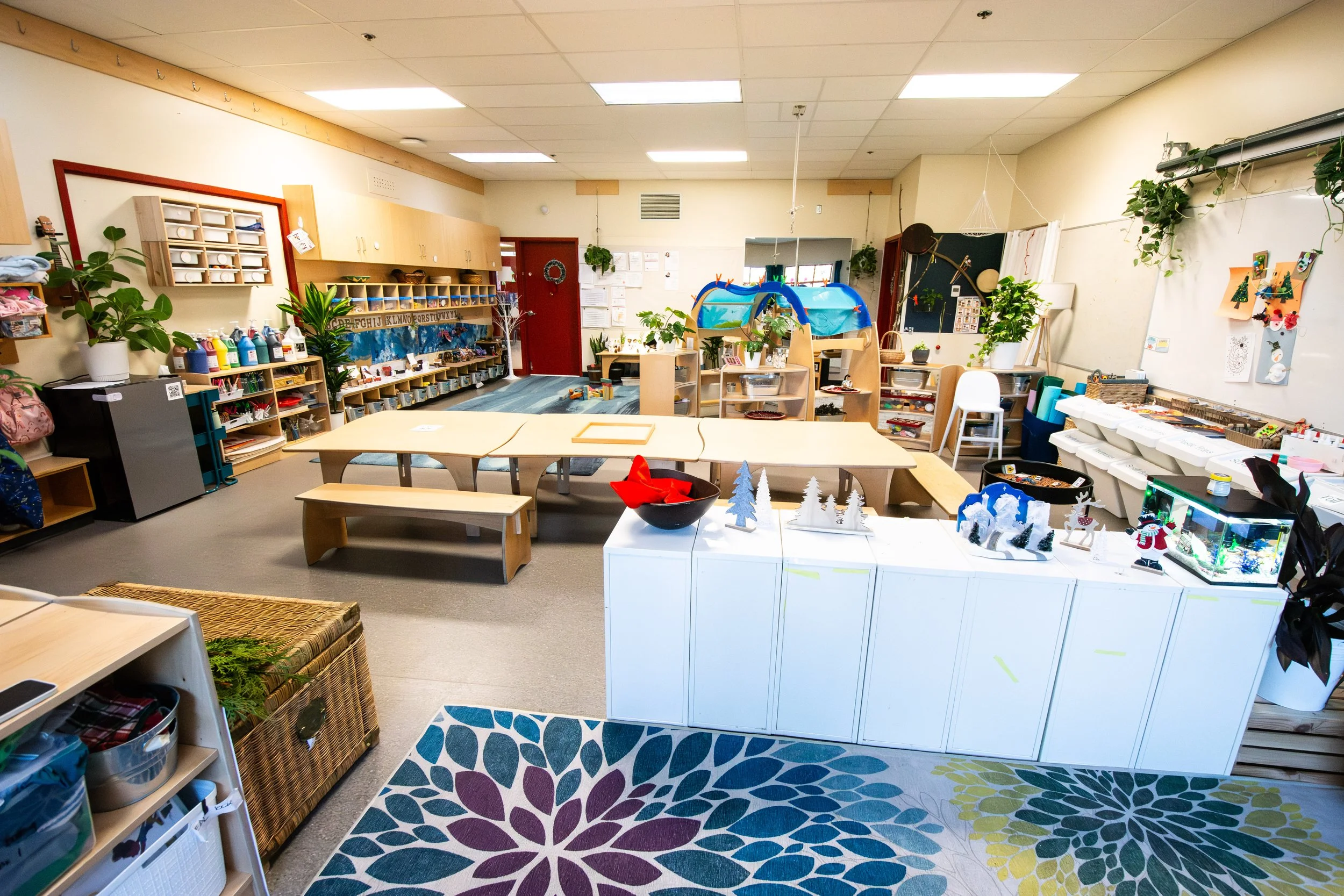
When you walk into one of our Richmond classrooms, such as Heron Toddlers and Junior Kindergarten at Mitchell Elementary, Northriver Junior Kindergarten at Tait Elementary, or Sandpiper at Manoah Steves, the first thing you might notice is what is not there. There are no "teacher made" displays or handprint crafts. Instead there is a focus on expressive art materials, support for open-ended play, and specific materials and displays to support project work.
Natural materials at child height: wood, clay, fabric, plants, baskets, and real tools.
Documentation panels showing the children's recent thinking: photographs, transcribed conversations, drawings, and questions.
Open-ended "provocations": small, beautiful setups designed to spark curiosity, such as a tray of pinecones beside a magnifying glass, or a basket of mirrors next to paint.
A studio space, or atelier, where children explore materials in depth.
The pace is also different. Reggio-inspired educators do not rush children through activities. A child might spend several days, or several weeks, exploring the same idea: what makes shadows move, how to build a bridge a friend can walk under, or what happens when you mix red and yellow paint with a single drop of black.
The atelier: a creative studio for young thinkers
One of the most distinctive features of a Reggio-inspired program is the atelier, or art studio. At SSOCC, every classroom includes a strong atelier space where children can work with materials in depth. Past and current ateliers have included drawing, sculpture, mixed media, photography, fibre arts, gardening, engineering, music, paint, clay, wire, and light.
The point of the atelier is not to produce a craft to take home. It is to give children time and tools to think with their hands. A child rolling clay is testing physics, geometry, force, and patience. A child arranging stones on a light table is exploring pattern, balance, and beauty. This is what we mean by the 100 languages: children are doing serious intellectual work, even when there is no worksheet in sight.
Why does this matter for your child's development?
The experiences children have in early childhood shape mental health, emotional regulation, social skills, academic readiness, and even adult earnings and relationships. Peer-reviewed research continues to find that early learning programs with a strong social-emotional focus, such as SSOCC's Reggio-inspired child care programs, are linked to positive academic and developmental outcomes in a way that other programs simply are not.
A Reggio-inspired environment supports development in ways that more rigid programs often miss:
Executive function: long projects build planning, focus, and the ability to hold an idea in mind across time.
Social-emotional skills: group projects require negotiation, perspective-taking, and conflict resolution.
Self-regulation: calm, beautiful environments lower stress and support emotional learning.
Creativity and divergent thinking: open-ended materials reward children for finding more than one right answer.
Confidence and identity: when educators take a child's ideas seriously, children come to see themselves as thinkers.
What to look for when touring a Reggio-inspired daycare in Richmond or Vancouver
If you are touring early learning programs in the Lower Mainland, here are questions and signals that tell you whether a program is genuinely Reggio-inspired or just borrowing the vocabulary:
Ask about long-term projects. Can the educator tell you about a project the children are currently exploring, and how it grew from the children's interests?
Look at the walls. Is there documentation of children's thinking, such as photos, quotes, and drawings, or just identical commercial decorations?
Notice the materials. Are children offered real, natural, open-ended materials, recycled materials, and real-life tools?
If you are able to observe the program while it is operating with children, watch educator-child interactions. Do educators ask open questions, listen, and let children lead, or mostly direct and correct?
Ask about outdoor time and nature. Reggio-inspired programs treat the outdoors as a learning environment, not a break.
Ask about parent involvement. Reggio Emilia's history is rooted in deep partnership with families. SSOCC programs are parent participation programs for that reason.
SSOCC's Reggio-inspired programs in Richmond and Vancouver
SSOCC operates Reggio-inspired programs across Richmond and Vancouver:
Heron Toddlers (12091 Cambie Road at Mitchell Elementary), for children 12 to 36 months
Heron Junior Kindergarten (opening July 2026), for children 30 months to school age
Northriver Junior Kindergarten (10071 Finlayson Drive at Tait Elementary), our existing $10 a Day site
Southlands Multi-Age Childcare (6426 Dunbar Street, Vancouver), for children 12 months to school age
Sandpiper and Heron School-Aged Care, Reggio-influenced after-school care for K to Grade 7
Common questions about Reggio-inspired childcare
Is Reggio-inspired childcare the same as Montessori?
No. Both honour the capable child and prepare beautiful environments, but Montessori uses specific structured materials with defined uses and "correct" outcomes. Children in a Montessori program are more likely to work independently or in small partnerships; Reggio programs offer open-ended materials, and children work in small or large groups frequently.
Will my child learn to read and write in a Reggio-inspired preschool?
Yes, but through project work, storytelling, mark-making, and rich language, rather than worksheets or direct academic instruction. Research consistently shows that strong oral language, social-emotional skills, and self-regulation in the early years predict later literacy success better than direct instruction at a young age.
How do I find a Reggio-inspired daycare in Richmond, BC?
Look for programs that explicitly identify as Reggio-inspired, ask the questions above, and tour in person. Reggio cannot be faked once you see it in action.
Tour a Reggio-inspired classroom in Richmond or Vancouver
The best way to understand Reggio-inspired learning is to walk through a real classroom. You can contact our registrar at registration@ssocc.ca to arrange a tour, or join the waitlist for Heron Toddlers, Heron JK, Northriver JK, Southlands, or our school-age programs.
Children are capable, curious, and ready to learn, and we believe SSOCC has built the kind of environment that honours that. We would love to show you what that looks like in practice.
