
Nature-Based Learning in Richmond, BC: Why Outdoor Play Builds Stronger Brains in Early Childhood
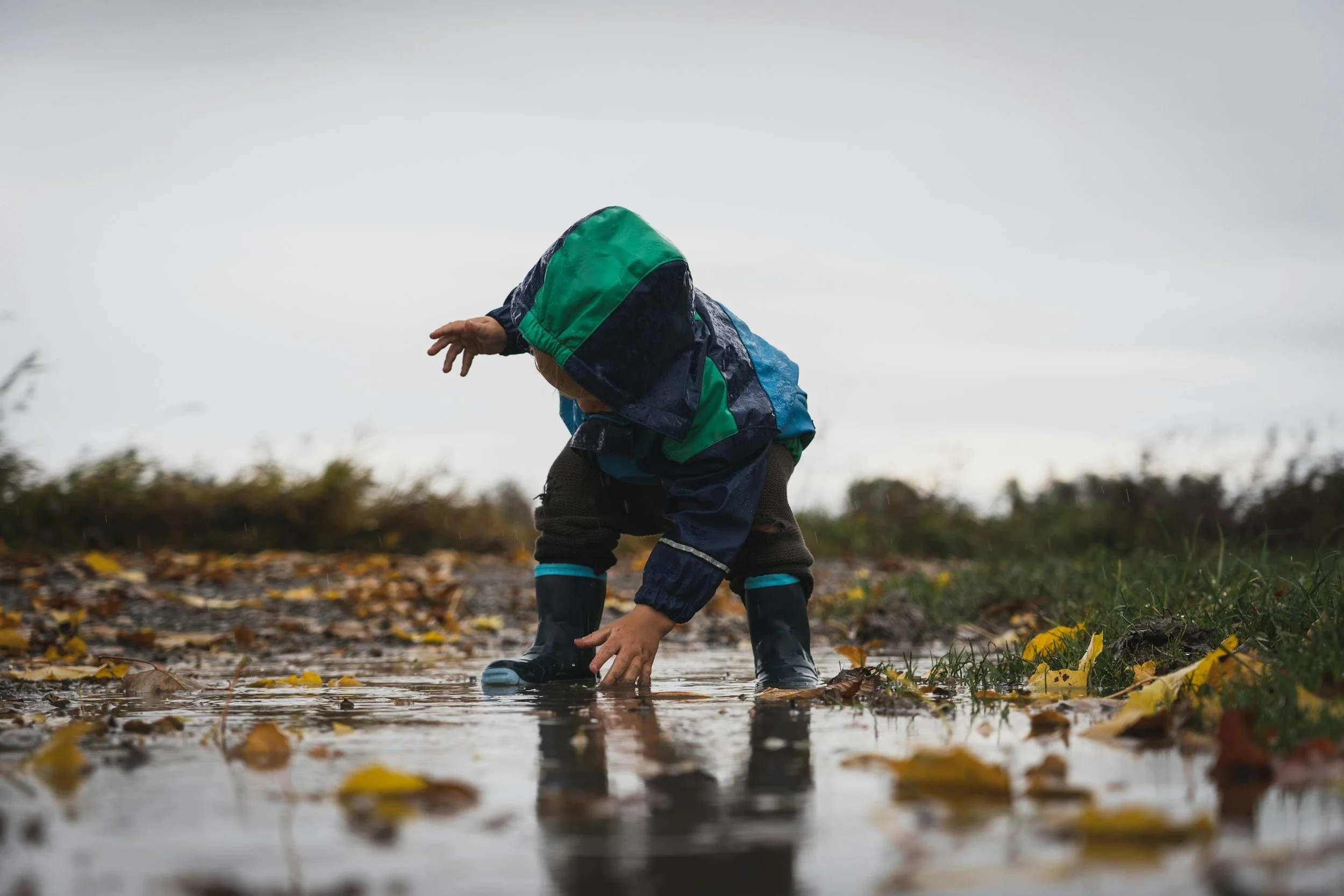
Walk past Mitchell Elementary on a wet Wednesday morning and you might see a group of three-year-olds in rain pants, knee-deep in a puddle, watching the way water moves around their boots. Walk past Tait Waterfront Park on a sunny afternoon and you might see four-year-olds tracking a heron through the marsh, pointing out the eelgrass, naming the sound of the wind in the cottonwoods.
Land-based (or nature-based) learning is one of the foundations of how SSOCC programs in Richmond and Vancouver teach young children. Below, we explain what nature-based early learning actually is, why the research is so strong, and how families can recognize a genuine nature-based program when they tour one.
What is nature-based learning in early childhood?
Nature-based learning is an educational approach where the natural world is treated as a primary teacher, not a backdrop. In a nature-based early learning program, children spend significant time outdoors in every season, work with natural materials indoors, and follow extended investigations rooted in real-world phenomena — light, weather, plants, water, animals, soil, and seasonal change.
Nature-based programs in BC span a range of intensities, from full-day "forest schools" where children are outdoors the entire day, to integrated approaches like SSOCC's, where outdoor learning is a significant part of our day…but not the only environment we learn in. What unites all nature-based programs is a shared belief: young children learn best when they are in deep, regular contact with the natural world.
What does the research say about nature and child development?
The evidence base for nature-based learning in early childhood has grown substantially over the last two decades. What researchers are finding — consistently, across countries and age groups — is that time in nature isn't just good for children's bodies. It shapes how they think, how they feel, and how they get along with each other.
Here's what the research actually shows:
Stronger executive function. Executive function is the set of mental skills that lets a child plan ahead, hold information in mind, and resist impulses — the skills most predictive of school success. A study published in the Journal of Environmental Education found that children attending nature preschools showed significant executive function skill growth — growth that exceeded what would be expected for typically developing children. The unstructured, open-ended nature of outdoor play seems to be part of why: children have to make real decisions, navigate real problems, and follow through on real plans. ERIC
Lower stress. Children's stress levels don't always look the way we expect — sometimes a struggling child is a stressed child, not a defiant one. Research tracking cortisol (the body's primary stress hormone) has found that children who participated in regular outdoor schooling in a forest once a week showed a significant reduction in cortisol levels on the days when teaching took place outdoors. Calmer bodies tend to be readier learners. PubMed Central
Better focus and attention. This one is especially meaningful for children who find concentration hard. Researchers Andrea Faber Taylor and Frances Kuo have spent decades studying what they call Attention Restoration Theory — the idea that natural environments give the brain's attention systems a genuine rest. Their research found that children function better than usual after activities in green settings, and that the greener a child's play area, the less severe their attention deficit symptoms. Even a twenty-minute walk in a park made a measurable difference. Sage Journals
Cooperation, empathy, and social negotiation. Outdoor play is messier and more open-ended than most indoor play — and that's exactly why it builds social skills. The typically self-directed nature of outdoor play supports the development of children's social and emotional skills, including empathy, talking about emotions, cooperating with others, and engaging in positive interactions. When there's no predetermined right answer — no single way to use a stick, cross a stream, or build a fort — children have to actually talk to each other. PubMed Central
Scientific thinking. Watching a snail move, tracking a shadow across the morning, noticing that the creek runs faster after rain — these aren't just pleasant moments. They're unforgettable, self-directed hypothesis testing. Spontaneous, open-ended play in natural surroundings offers unrivalled opportunities for early learners to classify, observe, explore, and interpret the phenomena around them. This is how scientific curiosity actually develops — not from worksheets, but from wondering. Informalscience
Physical health. More time outdoors means more movement, more sunlight, and stronger gross motor development. Risky outdoor play has been associated with increased physical activity levels, decreased sedentary behaviour, and improved mental health. Children who move their bodies well tend to feel more confident in them, too. nih
Risk competence. Learning to manage age-appropriate physical challenges — climbing a low tree, crossing stepping stones, balancing on a log — builds something researchers call risk competence: the ability to assess a situation, make a judgment call, and act on it. A scoping review of 40 empirical studies found that authentic child agency and autonomy are critical mechanisms through which these benefits are realised — meaning it's not just the physical experience that counts, but the child's own choice to take it on. nih
Taken together, this research points in a clear direction: outdoor-rich early childhood programs tend to produce calmer, more focused, more socially capable, and more curious children.
How SSOCC puts nature-based learning into practice in Richmond and Vancouver
Every SSOCC program has a different physical location, community and indoor environment , but all of them treat the outdoors as a learning environment. Here is what nature-based learning looks like at each location.
Heron Toddlers (12091 Cambie Road, Richmond)
Our youngest children spend daily time on the Mitchell Elementary playground and gardens, at King George Park, using the Richmond nature trails and in their own outdoor classroom adjacent to the program. Our cooking program lets toddlers prepare a shared snack using fresh ingredients — connecting nature, food, and community.
Heron Junior Kindergarten (12091 Cambie Road, Richmond)
Opening July 2026, Heron JK uses an outdoor classroom, the Mitchell Elementary playground, King George Park and the Richmond Nature Trails system. Children participate in long-term outdoor investigations across seasons. Offsite field trip days include Terra Nova Adventure playground and South Arm park.
Northriver Junior Kindergarten (10071 Finlayson Drive, Richmond)
Northriver children regularly visit the Tait Elementary playground, the Richmond dyke trail, Tait Waterfront Park East and West, Terra Nova Park, and King George Park. The proximity to the dyke and waterfront makes year-round nature investigation a defining feature of the program.
Southlands Multi-Age Childcare (6426 Dunbar Street, Vancouver)
Southlands has a large fenced garden and yard for everyday outdoor play. While this program is primarily a 1 educator program, when support educators or parent volunteers are scheduled this program will access Musqueam Park and trail and Pacific Rim Park.
Sandpiper and Heron School-Aged Care
Our school-aged programs use Manoah Steves park and Mitchell Elementary playground daily, with field trips to parks, pools, and recreation facilities during professional development days, winter and spring camps, and summer camps.
What about rain, cold, and Lower Mainland weather?
"There is no bad weather, only bad clothing" is a tired phrase, but in BC it is true. Children in SSOCC programs go outside in light rain, fog, cold mornings, and warm afternoons. The exceptions are extreme weather, air quality advisories, or unsafe conditions.
Practically, this means families enrolled in a nature-based program in Richmond will need:
- Waterproof rain jacket and rain pants (not just water-resistant)
- Sturdy rubber boots with warm liners for cold weather
- Indoor shoes that stay at the program
- Layers for cool mornings that warm up
- A change of clothes — sometimes two
- Sun hat and sunscreen for the long summer
Our staff help families build out the right gear list during onboarding. Once you have it, daily outdoor learning becomes effortless — your child barely notices the rain, and you stop checking the weather app.
Nature inside the classroom: bringing the outdoors in
Nature-based learning is not only about going outside. It is also about how the indoor environment carries the natural world. In our Reggio-inspired classrooms, you will see:
- Baskets of stones, shells, seedpods, and bark — collected by children themselves
- Living plants and, in some classrooms, classroom pets or visiting creatures
- Natural light prioritized over fluorescent
- Wood, fabric, and clay rather than primarily plastic
This connection between indoor and outdoor is part of what makes nature-based, Reggio-inspired early learning distinctive. Children are not switching between "school" and "nature" — they are inhabiting one continuous environment.
Frequently asked questions about nature-based early learning in Richmond
Is nature-based learning the same as forest school?
Forest school is one specific model of nature-based learning where children spend all of the day outdoors in a natural setting. SSOCC integrates nature-based learning into a broader Reggio-inspired program with rich indoor and outdoor environments. Both approaches share core values; they differ in time allocation and structure.
In BC, child care programs that do not have a licensed indoor space are unable to provide licensed child care. This means that licensing oversight and access to government funding or subsidies is not available; ratios, staff qualifications, criminal record searches, and best practices are determined by individual operators and not by BC’s child care licensing departments.
Is nature-based childcare more expensive in BC?
Not at SSOCC. Our fees for nature-based, Reggio-inspired programs are aligned with other licensed childcare in Richmond and are further reduced through CCFRI and ACCB. Northriver Junior Kindergarten remains an existing $10 a Day site.
What age can my child start nature-based learning?
Any age. Our Heron Toddlers program supports children from 12 months — the outdoor experiences are calibrated to development, but daily nature time begins on day one.
How do I find a nature-based daycare in Richmond or Vancouver?
Tour programs in person. Ask how often children go outside, in what weather, where they go, and what long-term outdoor investigations are currently happening.
Tour a nature-based program in Richmond or Vancouver
If you want your child to grow up confident in the rain, attentive to the world around them, and surrounded by educators who treat nature as essential to learning, we would love to meet you.
Reach our registrar at registration@ssocc.ca to arrange a tour at Heron Toddlers, Heron JK, Northriver JK, Southlands, or one of our school-aged programs.
Sources
Zamzow, A. & Ernst, J. (2020). Supporting school readiness naturally: Exploring executive function growth in nature preschools. Journal of Environmental Education, 51(5).
Dettweiler, U., et al. (2017). Stress in school: Some empirical hints on the circadian cortisol rhythm of children in outdoor and indoor classes. International Journal of Environmental Research and Public Health, 14(5).
Faber Taylor, A., & Kuo, F.E. (2011). Could exposure to everyday green spaces help treat ADHD? Evidence from children's play settings. Applied Psychology: Health and Well-Being, 3(3), 281–303.
Faber Taylor, A., Kuo, F.E., & Sullivan, W.C. (2001). Coping with ADD: The surprising connection to green play settings. Environment and Behavior, 33(1), 54–77.
Brussoni, M., et al. (2015). What is the relationship between risky outdoor play and health in children? A systematic review. International Journal of Environmental Research and Public Health, 12(6), 6423–6454.
Johnstone, A., et al. (2025). Risky outdoor play and adventure education in nature for child and adolescent wellbeing: A scoping review. PMC/National Institutes of Health.
Kellert, S.R. (2005). Building for Life: Designing and Understanding the Human-Nature Connection. Washington, DC: Island Press.
