
Reggio Documentation Explained: What Those Photos and Quotes on the Wall Really Mean
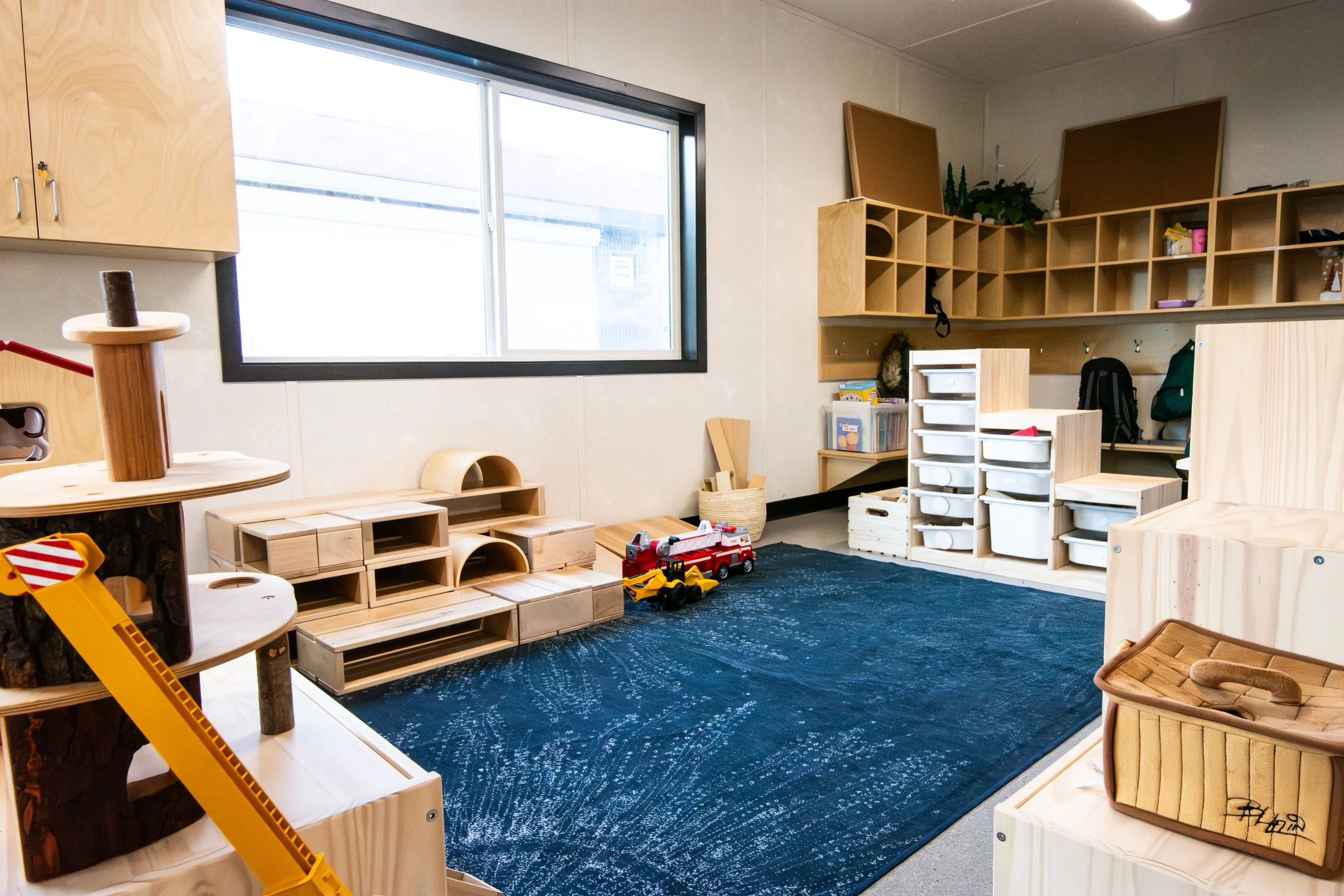
The first time you walk into a Reggio-inspired classroom, the walls can be a little disorienting. Instead of laminated alphabet posters, you may see photographs of children working with materials. Instead of brightly coloured commercial decorations, you see transcribed quotes. Drawings paired with names and dates. Project artifacts hung at child height. Long story-like sequences across whole wall spaces.
Or perhaps the classroom is more of a "living classroom", and the project work and ongoing material explorations are in varied stages of completion throughout the classroom.
This is pedagogical documentation, and it's one of the defining practices of Reggio Emilia-inspired early learning. It's also one of the strongest signals you can use when evaluating a Reggio-inspired daycare or preschool in Richmond or Vancouver.
Notably, pedagogical documentation is also a requirement of the BC Early Learning Framework - the Early Childhood "curriculum" for BC.
This is what documentation is, why it matters, and what to look for when you see it.
What is pedagogical documentation?
Pedagogical documentation is the practice of carefully recording, displaying, and reflecting on children's learning over time. It uses photographs, transcribed conversations, children's drawings or constructions, observation notes, and sometimes video — not as a record of finished products, but as a window into children's thinking as it unfolds.
The roots are in Reggio Emilia, the Italian municipal early childhood system whose practices have inspired educators around the world. In Reggio, documentation grew out of a conviction that children's thinking is valuable, that it deserves to be taken seriously, and that the act of recording it makes it visible to everyone who shares the learning community — children, families, educators, and visitors.
It's different from "displaying children's work." A laminated row of pumpkin handprints is not documentation. A panel that shows a child's three-week investigation into shadows — the questions they asked, the drawings they made, the conversations they had with friends — is.
Why documentation matters for your child's development
When educators document, several things happen:
Children see themselves taken seriously. A two-year-old whose words about caterpillars end up transcribed on the wall starts to understand that their thinking is worth attending to. This is a powerful identity message.
Children revisit and extend their learning. A child who looks back at a photo of yesterday's structure can decide what to try today. Documentation is memory made shareable.
Educators slow down and look closely. Documenting forces educators to notice details they might have missed. It's a teaching practice for educators as much as a learning practice for children.
Families see what their child actually does. A pickup conversation that starts with a documentation panel — "this is the project they've been working on" — goes deeper than "how was your day?"
The classroom becomes a record of relationships. Over a year, documentation tells a story of a specific group of children and educators learning together. It's irreplaceable.
What documentation looks like in practice
In our Richmond and Vancouver classrooms, you might see:
Project panels — Long, illustrated walls following a sustained investigation across days or weeks. A panel might trace how a group of four-year-olds explored what makes a shadow, including their hypotheses, the photographs of their experiments, the transcribed conversations, and the drawings they made along the way.
Daily moments — Smaller documentation pieces that capture a single conversation or interaction worth holding onto are shared with parents via our app, OWNA.
Atelier documentation — Records of what children are doing with specific materials (clay, light, paint, natural objects) and what ideas they're developing.
Children's "theories" — Transcribed quotes capturing how a child explains something they're trying to understand. "I think shadows are when the light gets tired" is the kind of thing you might find on a documentation wall.
Family contributions — Photos from home, family stories, or messages that link the classroom to the wider community.
What documentation tells you about a program
This is the practical part for families touring a Reggio-inspired daycare or preschool. The documentation on the walls is one of the clearest windows into how the program actually works.
What strong documentation tells you:
Educators are listening to children. You can read children's words, see their drawings, and trace their ideas. The children's voice is present.
Learning is long-term, not week-to-week themes. A wall that shows a four-week project is different from a wall that shows last week's "fall theme."
Educators understand what they're observing. Documentation is paired with educator reflection — not just a photo and a date, but a sense of what was important about that moment.
Children's thinking is taken as the starting point. The documentation responds to what the children did, rather than imposing a curriculum.
What weak documentation tells you:
Cute displays instead of children's thinking. If you see lots of identical art products and no children's words, the program may not actually be Reggio-inspired.
Adult-driven themes. Documentation that traces "the educator's plan for the week" or a monthly "theme" instead of "what the children explored and what learning concepts are they working on" is a different practice.
No documentation at all. A program that claims to be Reggio-inspired but has nothing on the walls beyond decoration may be using the label loosely. Note that many programs do digital documentation, so if you don't see pedagogical documentation, ask if they use an app. If they do, ask what sort of things are shared with families via the app.
Questions to ask about documentation on a tour
If you're touring a program, useful questions include:
"Can you walk me through one of these documentation panels?"
"What project are the children working on right now, and how did it start?"
"How do you decide what to document?"
"How do families see and engage with documentation?"
"How are teachers supported to work as a team to reflect on projects and curriculum?"
A program where educators light up when answering these questions is a program where documentation is likely part of their day to day practice.
The role of the atelier in documentation
Reggio-inspired classrooms include an atelier, or art studio — a creative studio for working with materials in depth. The atelier is one of the richest sources of documentation, because it's where children's thinking with materials is most visible.
At SSOCC, every classroom has a changing atelier. Past and current ateliers have included drawing, sculpture, mixed media, photography, fibre arts, gardening, engineering, music, paint, clay, wire, and light. The documentation of atelier work often becomes some of the most meaningful records of a child's year.
Documentation at home
Documentation isn't only a classroom practice — it can extend into family life. Families who get curious about Reggio often start small documentation practices at home:
A simple notebook where you transcribe interesting things your child says
A photo album of long-term play or building projects
A drawing folder organized by date so you can see growth over time
A shared wall where the family writes down questions the child has asked
These don't have to be polished. The act of paying attention is the point.
Common questions
Is documentation the same as scrapbooking? No. Scrapbooking is family memory-keeping focused on milestones and aesthetics. Pedagogical documentation is focused on children's thinking and learning, and is used by educators as a teaching tool.
Does my child have access to the documentation? Yes. In a Reggio-inspired classroom, documentation is at child height and revisited regularly with the children. It's part of how children themselves come to understand what they're learning.
Will I get to take documentation home? Some pieces, yes — but the most powerful documentation lives in the classroom, where it can be revisited and built on. Many programs share photos and excerpts digitally with families.
How is documentation different from a portfolio? A portfolio is a collection of an individual child's work. Documentation is often about a group's investigation. Both can exist in the same program.
Where can I see documentation in action? Touring a Reggio-inspired program is the best way. We'd be glad to show you what documentation looks like in any SSOCC classroom — book a tour now online at www.ssocc.ca!
See documentation in our Richmond and Vancouver classrooms
Documentation is hard to describe and easy to recognize once you've seen it. We'd love to walk you through what our educators have been recording lately at Heron Toddlers, Heron JK, Northriver JK, Southlands, or our school-aged programs.
Email registration@ssocc.ca or book a tour on our website to see how children's thinking shows up in our programs.
