
How to Choose Quality Childcare in Richmond, BC: 7 Questions to Ask Before You Tour

Choosing childcare is one of the biggest decisions you'll make as a parent. The right program shapes how your child learns, makes friends, and develops confidence and curiosity. The wrong fit means months of stress for the whole family.
A post-covid decline to the birthrate, an avalanche of new centres opening, and the downturn to the economy means that currently there is a surplus of licensed childcare in Richmond for children ages 0-6. This means families can slow down long enough to get more information about the program - practical and logistical information is a starting point. But what determines family satisfaction with the child care centre will depend on the program teaching approaches and curriculum, and if these match parent expectations for childcare.
These eight questions can help.
1. Is the program licensed by Vancouver Coastal Health?
Every legitimate group childcare program in Richmond must be licensed under BC's Community Care and Assisted Living Act. Licensing checks ratios, educator qualifications, space, health, and safety. Licensing investigates complaints and incidents.
If a program is licensed, you can find it on BC Child Care Map. Note that brand-new programs can take up to 6 months to appear on the BC Child Care Map. https://maps.gov.bc.ca/ess/hm/ccf/
Additionally, it is a legal requirement for a licensed child care program to display their valid BC Child Care license in the classroom.
If a program is licensed, you can search for the program and their inspection reports at the Vancouver Coastal Health Child Care Inspections Reports website: https://inspections.vch.ca/#/6e0e9442-3016-4294-83f4-0ea25b22ec5b/disclosure
2. What are the ratios, and what are educators' qualifications?
Childcare ratios matter. Ratios address how many adults : children are in the classroom at any given time. They also address the adult qualifications.
BC child care ratios are as follows:
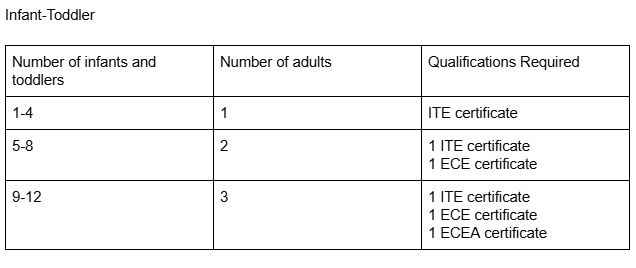
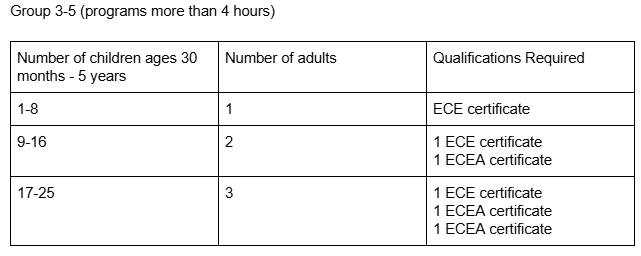
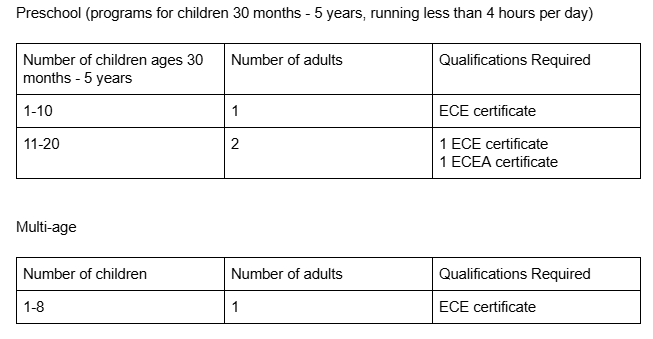
A licensed child care program must legally follow these ratios. However, many programs will offer additional teachers beyond ratio requirements. Ask: "Do you have staff in the classroom in addition to the ratio-required educators? How many educators hold their ITE or ECE certificates? Do you have any support aides or 1:1 support teachers in place right now?”
At SSOCC, we follow all legal ratios and will often have an additional part time staff or consultants for inclusion support. We believe strongly in supporting lifelong learning and professional growth - as such, we prioritize hiring only fully qualified educators (ECE or ITE). Our educators also complete at least 32 hours of professional development per year — well above the BC minimum of 8 hours per year.
3. What is the program's educational philosophy?
"We follow the children's interests" is a fine answer — if the educator can tell you what that actually looks like this week. Quality programs have a clear philosophy and can describe it in real, concrete terms.
Listen for: a named approach (Reggio-inspired, Montessori, play-based, emergent curriculum), evidence of long-term projects rather than rotating themes, and children's thinking documented on the walls — photos, drawings, transcribed conversations.
SSOCC is Reggio-inspired, with structured social-emotional curricula layered in. We're happy to walk you through what's currently happening in any classroom during a tour.
4. How does the program handle big feelings and conflict?
This might be the most telling question on the list. How a program responds when children struggle tells you everything about its values.
Ask: "How do you handle conflict between kids? Do you use any social-emotional curriculum?"
Strong answers include using language that validates feelings before redirecting behaviour, teaching problem-solving skills, using positive adult-child relationships to provide comfort and a clear emphasis on emotional vocabulary and self-regulation.
Avoid programs that lean on punishment, time-outs, emotional shaming or forced compliance as the main tools.
5. How much time do children spend outdoors — and where?
In the Lower Mainland, daily outdoor time is one of the most consistent signs of a quality program. Good programs go outside in light rain and cool weather, not just on sunny days.
Ask: "How often are children outside? What's your rainy-day policy? Where do you go beyond the playground? Are there any occasions when you would not be going outside for the day?”
SSOCC's Toddler and Junior Kindergarten programs, for example, makes regular use of the Richmond Dyke trail, Tait Waterfront Park, Terra Nova, and King George Park — not just the schoolyard.
6. How does the program support children with diverse needs?
Even if your child doesn't currently need extra support, a program's approach to inclusion tells you a lot about its values.
Listen for familiarity with tools like ASQ and ASQ-SE developmental screening, Supported Child Care and PACE funding, experience working alongside Behaviour Interventionists or OT/PT/SLP/RCC therapists, and willingness to build individualized care plans.
Ask: "Do you have a needs support policy or policies around inclusion? What happens when a child needs extra support in the classroom? How are educators trained and supported to provide safe, inclusive care?”
At SSOCC, inclusion isn't a special category — it's how we think about every child. For several years we have received gaming funding to employ an Inclusion Coordinator, to support inclusion in our programs.
7. What does communication with families look like?
Some programs offer brief end-of-day updates. Others share photos throughout the day, hold parent-educator conferences, and run family education evenings. Some programs will use apps such as HiMama, Brightwheel, SeeSaw, Storypark or OWNA while others rely on monthly newsletters.
Ask: "How do you keep families in the loop day to day? Do you offer parent-educator meetings? Is participation required?"
SSOCC 0-6 child care programs are parent participation programs, which means a monthly volunteer shift and a deeper sense of community. Parent participation isn't the right fit for every family — but for those who want it, it's one of the most meaningful things a childcare program can offer.
Red flags to watch for on a tour
Most programs in Richmond are genuinely good. A few things worth paying attention to:
Educators not making eye contact with children, or speaking sharply
Children appearing disengaged or watching screens for extended periods
No visible evidence of children's recent work
Vague answers about philosophy, conflict, or inclusion
Frequently asked questions
How early should I start looking? As early as pregnancy for infant-toddler programs. Quality programs in Richmond often have long waitlists. Join several early.
Are home-based daycares lower quality than centres? No! Licensed family childcare can be excellent and are a great fit for many children and families. The same questions apply.
What's the best age to start childcare? There's no single right answer. Many families start between 12 and 24 months when parental leave ends. Quality matters more than timing.
How do I book a tour at SSOCC? Email registration@ssocc.ca to request a virtual or in-person tour of Northriver JK, Sandpiper, or Heron Toddlers. Heron JK and Southlands use open house registration.
Come see for yourself
The best way to assess quality is to walk through a real classroom and watch what happens. We'd love to have you. Reach out at registration@ssocc.ca to get started.
Frequently asked questions about choosing childcare in Richmond
How early should I start looking for childcare in Richmond, BC?
As early as pregnancy for infant-toddler programs. Quality programs in Richmond often have multi-month or multi-year waitlists. Joining several waitlists early is the most realistic strategy.
Are home-based daycares lower quality than centres?
Not necessarily. Licensed family childcare can be excellent, particularly for younger toddlers. The same questions apply: ratio, qualifications, philosophy, outdoor time, communication.
What is the best age to start childcare?
There is no single best age. Many families start between 12 and 24 months when parental leave ends. Quality matters more than start age.
Where can I find a tour at SSOCC?
You can request virtual or in-person tours of Northriver JK, Sandpiper, or Heron Toddlers by emailing registration@ssocc.ca. Heron JK and Southlands use open house registration.
Tour our Richmond and Vancouver programs
The best way to assess quality is to walk through a real classroom and talk to the teachers. We would be glad to host you at any of our six programs. Reach out at registration@ssocc.ca to begin.
